mercredi 26 mai 2021

Palestinian human rights: The historical task of the Righteous Among the Jews

Today, and since their Nakba in 1948, Palestinians are suffering severe deprivations of basic human rights by the state of Israel, deprivations which amounts to the level of crimes against humanity. In my opinion, ending this tragedy will require the concurrence of multiple struggles. The first and foremost is the struggle of Palestinians themselves, in an organised way, free of existing rotten political parties (OLP/Hamas) together with their dead-end ideologies (nationalism/islamism), and unified across the many dividing frontiers created by Israel. Basically it's a struggle inspired by the first Intifada before it got sold out by the Palestinian leadership during Oslo accords. The second is the struggle of human rights organisations on the international scene, by using all possible means to share and defend the Palestinian narrative in front of the hegemonic Israeli narrative. The third is the struggle of Jews in general, and especially in Israel, to stop the crimes that are perpetrated in their names. In this article, I would like to discuss the latter, which I call the struggle of the Righteous Among the Jews. It's a reference to "Righteous Among the Nations', an honorific term used to describe non-Jews who had the courage to save Jews from Nazi extermination during World War II. 

I strongly believe that you, the Righteous Among the Jews, have a historical role to play today to end the Palestinian tragedy on one hand, and save the Jewish communities on the other hand from the dangerous repercussions of the Zionist enterprise on them. I think that every human being, including Jews, would act as Righteous when the reality of injustice is understood. This article is a call for the rise of Righteous consciousness.

The first step of Righteous consciousness is to be curious about the other reality, the reality beyond the dominant Israeli narrative presented in mainstream media. In the last decades, this narrative focuses on the "terrorist security threat of the islamist Hamas, from which Israel has the right to defend itself", because it resonates with the western public, a public currently almost won to extreme right ideas. 

A great starting point to learn about the other reality is the very recent report by Human Rights Watch, which describes the apartheid and persecution of Palestinians in Israel. The following short video is showcased in the report.

In a nutshell, Palestinians are divided by force into separate and isolated communities:

  • Palestinian refugees that were expelled by Zionist militias during the Nakba, and have never been able to come back to their confiscated homes and lands. In general, this population live in overcrowded camps, spread across hosting countries like Jordan, Lebanon and Syria, where they are treated in inhuman way, and live in poverty. For example, in Lebanon, Palestinians in refugee camps do not hold citizenship Lebanese, and therefore they are not entitled to government services, such as health and education. Initially, the Palestinian exodus in 48 touched 700 000 persons, who became around 5 millions today with their descendants. They do not have the right to move to Israel, or the Occupied territories. Compare it to Jews born anywhere in the world, they can visit the aforementioned territories any time, and become Israeli citizens.
  • 1.6 Millions Palestinians living in Israel, and holding its citizenship. Although they represent almost 20% of Israel population, however they are concentrated in 3% of land because of systematic discrimination against them. For example, Israeli law permits small towns to exclude prospective residents based on their incompatibility with the town’s “social-cultural fabric”. This law results in more than 900 small Jewish towns that can restrict who lives there, and none of them have any Palestinians living among them. Even-though they are a second class citizen, Israeli-Palestinians suffer the least compared to the other Palestinian groups.
  • 2.1 Millions Palestinians living in Gaza, an open prison because of the blockade imposed by Israel, restricting the movement of people and goods. For example, only a minority of projects aimed at vital services in Gaza have been approved by the Israeli authorities, and implementation of approved projects is impeded by the limited capacity at the single crossing for goods. This translates for example to over 90% of water in Gaza being undrinkable, and 90% among Palestinian children and adolescents having experienced personal trauma. 
  • 2.7 Millions Palestinians living in the West Bank, which is divided in 3 Zones (A, B and C according to Oslo Accords), and mostly are governed under Israeli military law, except for Israeli settlers who are governed under civil laws. Palestinians rarely get any permits to build houses, or leave the West Bank, where Israeli settlers enjoy exclusive road networks, often built on expropriated Palestinian lands.
  • 400 000 Palestinians living in East Jerusalem, with residency being subject to revocability by Israeli authorities, like already the case of 15 000 Palestinians since 1967. With no construction permits delivered to Palestinians compared to Jews, and an active home demolition policy, more than 1,434 structures were demolished in East Jerusalem by Israeli authorities between 2009 and 2020.
To grasp the level of these oppressive policies, try the mental exercise of replacing, in any of the above paragraphs, Israel with Germany, Jews with Christians and Palestinians with Jews. Those would be just unimaginable situations in Europe no matter what is the excuse or the explanation. For example, If towns in Germany refuses to accept Jews in it to preserve its “social-cultural fabric”.


With these mind blowing facts, the second step of the Righteous consciousness is to ask why? Well, in my opinion, the root caue lies in the Zionist ideology, a nationalist settler colonial endeavour, that originally had a minor influence within Jews, but grew rapidly after the Nazi holocaust. Zionism quickly built alliances with western imperialist powers such as Britain historically, and currently the United States of America, to maintain its existence.

I will not dive into the ideology of Zionism, but you can read famous Jew scholars, like Noam Chomsky, Thomas Suarez and Norman Finkelstein, who asked the Why question, and then became very critical of Israel. Moreover, following the shock of the First Palestinian uprising (Intifada), and the declassification of Israeli government papers dating to the founding of the state in 48, a new generation of Israeli historians emerged in the 90s to question the hegemonic Israeli narrative. They are called the New Historians, and I personally read works of Ilan Pappé and Shlomo Sand. They deconstructed the myths on which the Israeli nationalist narrative is built, just like any other nationalist narrative of other countries. For example, in Lebanon, my country of origin, one of the nationalist narratives goes like this: We are a millennial nation, descendants of Phoenicians; our land is mentioned in the bible many times; we got the trade in our blood, and always victims of others wars on our land; etc... Of course, this is complete bullshit, and the worst, the narrative is mostly invoked to discriminate others.

The Zionist narrative goes like this: Jews around the world form a single nation, a chosen nation by God, who promised the land of Israel. They were forced out of Israel by evil Egyptians a couple of thousands years ago, and ever since they are persecuted across the world. Zionism, which is the political equivalent of Judaism, came to save Jews and return them to their original Land, an empty land for a people without a land. When they arrived, the Arab tribes voluntarily left and sold their deserted lands to them, then Jews worked the land and made it flourish. Ever since then, Arabs try to destroy Israel and throw them to the sea. Arabs made an alliance with Hitler, and keep refusing all peace opportunities with Israel, which don't leave Israel with any other choice but going to David against Goliath wars. However, during wars, Israel aims only at protecting its citizens from terrorists, by exclusively conducting chirurgical military operations, because it has the most moral defense army in the world. However, the arab terrorist do not have any morals, and they use Palestinians as human shields which cause lots of collateral damage. Israel is the only democracy in the Middle East, and any criticism towards Israel and Zionism is a hidden anti-semitism. Gladly, all of these myths were debunked by research of Israeli New Historians.


The Third step of the Righteous consciousness is to understand the consequences of Zionism on Jewish communities, since the consequences on Palestinians is obvious by now. I can think of four main consequences:
  • Zionism is rooted in religious and colonial ideology, and this inevitably lead to shifting Israel towards the extreme right in the political space. The founders of Israel belonged to leftists labour parties, and now the extreme right in Israel is dominating the political scene. Extreme right ideas is a prosperous ground to the rise of fascists to power, which has extremely dangerous impact on the Israeli society on the long term. There can't be democracy, freedom and equality together with Fascism and extreme right.
  • After decades of successful attempts to collapse Zionism and Judaism into a single thing, the criminal politics of Israeli state is damaging the image of Judaism globally, and thus fuelling Anti-semitic feelings and ideas.
  • Unless Israel is able to completely wipe out Palestinian population, Palestinian will keep resisting for their dignity, including with the usage of violence, which won't provide the security Israeli citizens are looking for. Every round of war in Gaza is proving this. 
  • Finally, the Israeli society has become very militarised, living in constant fear for survival and a Paranoia of the other. The military complex is sucking a major part of Israel resources, which are no more available to be employed to satisfy human needs in terms of education, health and so on.

Israel has enjoyed since the 67 war a full support of the United States on many levels: Financial, Military and political. For example, over the past five decades, the United States has vetoed at least 53 UN Security Council resolutions critical of Israel. The US support of Israel had and still have strong geopolitical ground thanks to the imperialist role Israel has offered to play in the region. However, the geopolitical alliances are not set in stone, and they might evolve according to the interests of US foreign policy, and the internal dynamics in the US. We can already feel a wind of change, with dissident voices raising in the Democrat camp raised by progressist congress men and women such as Rashida Tlaib, Alexandria Ocasio-Cortez and Bernie Sanders.


Now it's time for the forth and last step of the Righteous consciousness, the time for action. During World War II, no one told the Righteous Among the Nations how to act, they did what seemed to be right. I am asking you, Righteous Among the Jews to do the same. Here are some action possibilities:

  • Be curious, dive into history, outside of the usual Israeli narrative. Follow Israeli new Historians, read reports from human rights organisations and consider the perspective of Palestinians by checking their websites, or watching their films.
  • Share the Palestinian narrative with your surroundings, your friends, your family. Fight against dehumanisation of Palestinians, because this was always the first step to Genocides, and European Jews know this very well.
  • Raise the voice on any international platform to show that Zionism is not Judaism, and Israel is not the exclusive representative of Jews. 
  • Refuse to be part of, and deal with Israeli military organisations.
  • Refuse to consume goods and services produced on confiscated lands in the Palestinian occupied territories in an illegal manner according to international laws.

    You might risk being called a Self Hating Jew, and being in the difficult situation of a dissident, but that's nothing compared to what the history would tell about you if you stay silent. 

    Update: A couple of days after I wrote this blog, I stumbled upon a wonderful interview with Gabor Maté, a Jewish Holocaust survivor, one of these "Righteous Among the Jews" according to me, or probably a self hating Jew according to Zionists. 


    samedi 28 mars 2020

    Capitalism kills, not covid-19

    In the last article, I shared the story of how our intelligence as living creatures has evolved through time to allow us to control our world. But also our intelligence is still flawed because it's not able to protect our existence from major events like war, famine, economic crisis, climate change... and most recently covid-19.

    The flaw is in the way we organize our economy, in other words which goods and services we produce, how do we produce and distribute them, and what we do with benefits. We call the current organization Capitalism, in which a wealthy minority makes all of these decisions without any democratic control. Not only such concentrated decisions do not leverage the intelligence of all of us, but also tends to be biased for the interest of the few, which is simply opposed to the interest of all of us, human beings.

    Covid-19 pandemic is one of these crises where you can see the opposition of interests and how this opposition threatens our existence. On one side, you got large capital owners backed by national governments, and on the other side, there is us, the working people. Capitalist organization of our economies worsened the impact of covid-19 and made it a lethal virus. Let me make my point with some concrete examples.

    Capitalism requires sustained growth in profit to function. One of the ways to increase profit, is by reducing taxes. Companies avoid taxes either illegally or through "optimizations”, pressure governments to reduce taxes and even to subsidize them. For example, president Macron reduced taxes from 33% to 25% in France, and president Trump lowered it from 35% to 21%. These cuts are directly translated into less spendings in public services, including health care. There are no budgets to buy detection test units, masks, to provide enough beds or personnel to treat patients with covid-19. Patients are dying because they either can't afford private hospitals, or are not admitted in saturated hospitals or finally aree admitted but in quite too late stages.

    Capitalism prioritizes private profit over anything else, including public health. Most governments were delaying confinement to the last moment although risks were quite obvious from the experience of first affected countries like China. Governments were under a lot of pressure to avoid shutting down businesses, and even when it happened, large corporations were able to continue their businesses while risking the lives of their employees, despite the fact that some do not produce essential goods.

    Capitalism dig inequalities and impoverish people. In the strongest capitalist economy of the world, the United States,  a survey shows that 61% of American households can't afford an unexpected expense of 1000$ using their savings. In other words, during such crisis, you are pushing everyone to risk their health, and the health of others, by going out every day to work in order to survive financially.


    Capitalism only functions when there's profit. People's wants and need, including health, are not considered in the bottom line of financial reports. This means that when there's no profit to make, our economy collapses and people starve. In the current situation with covid-19, profits are slowing down, and this is threatening our economy and lives.

    History showed us that crises produces angry people, and this anger can either translate to fascist movements (2008 in UK/USA, 1929 in Germany), or socialist ones (1917 in Russia, 1929 in USA). I can only hope for socialist movements that can help us move beyond Capitalism to an economy organized based on a democratic basis, where every worker like me and you, has a vote and a say on what to produce, how to produce it and distribute it. We would reach, as humanity, a new level of intelligence, a common and conscious one.

    Spread the word, and stay safe because of course, covid-19 kills too!

    dimanche 19 mars 2017

    Intelligence, an adventure of complexity

    This article is a reflection on "Intelligence" development through its history which I try to project into the future. It is inspired to a large extent by the exceptional geneticist, philosopher and humanist Albert Jacquard, in a context of Artificial Intelligence (AI) rise and an extremely sick society (inequality, neo-fascism, terrorism..).

    Intelligence is evolving complexity. Complexity is when simple elements interact with each other, and surprise you with the outcome. According to Wikipedia, Complex is composed of the Latin words com (meaning: "together") and plex (meaning: woven) characterizing a system with many parts where those parts interact with each other in multiple ways, culminating in a higher order of emergence greater than the sum of its parts. If you take two inanimate Silex stones, and you scrub them together, they produce sparks!


    In the first phase of complexity evolution, a long period of 13,8 billion years, hazard (i.e. randomness) is the king. The word Hazard is derived from Andalusian Arabic Azahr, which means dice.
    • After the Big Bang, quantic perturbations created some irregularities in the big homogeneous soup that was our baby universe.
    • With the help of four fundamental forces (gravitation, weak, electromagnetic, strong) more and more complex structures were emerging: neutrons and protons, then atoms like helium and carbon, then molecules, then stars and planets.
    • One of these planets, the earth appeared 4.5 billion years ago and it was quite special because it had ocean and atmosphere, two protecting layers from dangerous and fatal cosmic rays. These layers preserved emerging complexity on earth from rapid destruction, and prepared them for next evolution.
    • 500 million years later, an amazing thing happened. The appearance of DNA molecules codified genetic information and gave it the possibility of duplicating itself, or as we now say, creating a backup of its data! That preserved it for next complexity evolution: formation of cells and bacteria, the first form of life. 
    • Another revolution happened 900 million years ago, which was sexual procreation instead of replication. In this paradigm, 2 genetic pools are mixed to produce a completely new and unique organism, instead of just replicating the same existing genome.
    • The last decisive natural hazard was a deformation in primate brain that happened a couple of million years ago. Indeed, a kind of hypertrophy that exploded the number of neurons up to 100 billion!!
    With that last master piece of natural selection and randomness, the universe gave us the physical potential to go even beyond. Nevertheless, that "beyond" was from now on in the hands of humans, not nature anymore.

    Some anthropologists say that the first step of moving out from animal state was when our ancestors got rid of jealousy. In fact, less male competition during mating seasons gave more place for group solidarity which is more robust against the uncertainty of nature. We are now ready for the next level of complexity: Society. Society is the crucial factory that transform our physical potential to a human being by developing our conscious. Thanks to other's "you" when addressing me, I become an "I", I become aware of my own existence, and that changes everything. Another important achievement of society is transmitting knowledge representation, in other words preserving acquired complexity, the same as DNA did to our genetic information. From that moment human never stopped conscious conquest of more and more knowledge, explore new fields, ask new questions, and control nature.

    What is the next step in the adventure of complexity? All eyes are now fixed on Artificial Intelligence. I recommend reading this article series for an excellent introduction to AI. In a nutshell, AI mimics human brain by creating software-based meshed neurons (Neural Network) that trigger an output according to the input. For example the input is an image, and the output is 1 if it's an image of a bird, and 0 otherwise. In order to have an intelligent Neural Network, we need to train it, i.e. give it thousands of images and make sure it adapts itself until it makes the correct bird identification. Neural Network creates knowledge representation through training.

    AI, NN are all old concepts to some extent, but gained a lot of traction recently thanks to cloud computing and big data. Indeed, training a NN requires a lot of computing power, and a huge amount of organized data. Today, our brain has 10 000 more computational power than the biggest known NN, and is very efficient energetically. With our abstract though, we don't need big data to learn, a couple of bird images are enough to identify the concept of a bird. It is the result of billions of years of training:
    • Visual perception: 540 million years of data
    • Bipedal movement: 230 million years of data
    • Abstract thought: 100 thousand years of data
    AI is an important breakthrough for humanity in its relation with intelligence and complexity, though big questions are yet to be answered. One of them is about machines becoming conscious of them selves, just like what happened to us.
    For me the next step of complexity is elsewhere. It's the common intelligence, the "com" (together) in complexity. Even though humanity made exponential progress, but it sill fails major challenges such as stopping wars, financial crisis, famine... The most flagrant one is climate change, which threaten our whole existence, but we are rushing into the tragedy just like the novel "Chronicle of a Death Foretold" of Marquez. Like homo became conscious of itself, we humans we must become conscious of "ourselves" as a whole and be masters of our destiny. On this idea Jesus Christ and Karl Marx agreed together:  "When you are united, I  (the superhuman) will be among you" - JC, "We do not find the essence of humanity in each human, but in the human community."- KM. The revolutions of the last centuries are somehow this next level of complexity trying to emerge.

    jeudi 2 mars 2017

    Video streaming security

    How can I protect my OTT platform from attacks? how can I stop bad people from stealing my content and monetizing it instead of me? Any OTT actor should be having these questions on video streaming security. In this post, I will share some answers from delivery (CDN) perspective, by building on my customers experiences. Video streaming security is tackled with respect to OTT platform & content components.


    Typically, the OTT platform (origin) sits behind a CDN. As a result, bad actors will either attack the origin through the CDN or completely bypass it and attack the origin directly. I suggest the following solutions and best practices to enhance your platform security:
    • Isolate the origin on a separate infrastructure from other services, like email server for example.
    • Avoid using easy-to-discover FQDN of the origin (such as my-origin.ottdomain.tv) and do not expose it publicly (better use a completely different domain name).
    • Whitelist on your firewall (a cloud-based firewall is even better) solely CDN IP ranges. Most CDNs can ensure that origin fill is done through a predefined IP range.
    • Use CDN parent cache in order to reduce traffic back to the origin. In certain cases, when an asset has a very distributed audience, all CDN edge servers will go back to the origin to fill, which might bring it down like a DDoS attack!
    • Use CDN based geoblocking in order to block traffic from countries where you do not have audience. For exemple, if not operating in Latin America, you would better block this region because it has a considerable DDoS botnet concentration.
    • Understand how your CDN is capable of mitigating DDoS layer 3/4/7 attacks.
    • Implement restrictions on CDN: block HTTP POST requests if not used, ignore query strings that are not part of your normal usage.

    I've got a lot of cases where customers have suffered from having their content appearing on third party websites and thus loosing potential revenues. The following solutions can help protecting against content theft:
    • Apply simple HTTP best practices on CDN like enforcing cross origin policy, and blocking requests based on Referrer header.
    • Authenticate streams on CDN by using cookie based (pay attention to cookies device compatibility and acceptable legal framework) or path based token authentication.
    • Add DRM protection to video workflow. This is the ultimate solution but comes with cost and complexity drawbacks since the DRM industry is still very fragmented and not standardized. Make sure that your CDN is compatible with the chosen DRM technology (for exemple Widevine’s WVM format requires that the CDN supports byte range requests).
    • Use TLS for video delivery in order to reduce the risk of a third party sniffing  your content on clear unencrypted channels. Make sure that your CDN is up to date in regards to the latest TLS security and best practices (secure cipher suits, OSCP-stapling, keep alive, false start...).
    • Contact CDN & IP providers of  websites which are stealing your content in order to block illegal content and dissuade them from continuing theft practices.

    One last advice, common to platform and content security, is monitoring CDN logs and building some relevant security oriented analytics around it to have better insights on your streaming and take actions quickly to mitigate any abnormal behavior.

    dimanche 25 décembre 2016

    Data driven communication

    I've noticed that in our communication, we often tend to pass judgment, which is processed information, instead of passing raw information. That is unfair to the ones that we are speaking to, because we do not give them the chance to have their own judgement. Not only it's unfair, but it is also source of misunderstandings and conflicts:
    • Upset customer about service: "Your network's quality is not good enough, we are receiving complaints from our users"
    • Excited business developer about a new opportunity: "Management should support me, this project will generate around 1M€ of revenues, huge one!"
    • Angry work colleague: "You did not reply to my emails several times this week"
    In all of the above examples, sent information is not objective. I will give in the following some tips for achieving healthier communication.


    The first golden tip would be: "A little less adverbs, a little more data!". Adverbs (too much, extremely, slightly, highly, nearly, very, quite, sometimes, seldom, often) without supporting data are pure judgment. Consider the upset customer again rather telling you, his network provider: "In the last week, the latency on your network was 150ms on average between our offices in Dubai and Paris, causing up to 10 user complaints regarding calls quality". In the first case, you are probably opening a ticket with your technical services in order to correct the issue, but in the second case, you are probably going to compare noted performance to contracted SLAs, might find it compliant, and thus propose a new feature (VoIP QoS) in order to improve the customer experience. In the first case, you are loosing time, whereas in the second you are generating new revenues.

    The second tip is backing absolute values with references for better appreciation. For example, compare sales growth rate of this quarter to the same quarter of last year and compare churn rate of your customer base to your industry average. Consider our excited business developer again: 1M€ is indeed a lot of revenues, but his company has limited resources and got in its pipe some other projects generating 10M€ each. It wouldn't be surprising that the 1M€ project will not get priority (a small confession: it's a true personal story!).

    The third tip is providing information about samples as well as about the population that we are sampling. Consider the angry colleague again. It's true that this week you didn't answer 5 of his emails, but he globally sent you over 100 mails, which means that you had around 95% responsiveness rate! the sample here is unanswered emails, but the population is sent emails. That would completely calm your colleague :)

    Using data in our communication is not about inhibiting the expression of our thoughts and emotions. On the contrary, you are free to add your own subjective judgement, as long as you provide the full picture backed with data. Not only you will give your interlocutor the chance to have his own judgement, but sometimes, by using objective data, your own perception and judgement can change. This is typically the case when your judgement is biased by temporary emotions.

    In this post, I gave mostly work related examples, but it's applicable to everyday communications: Better say "I love you like the ocean" than "I love you a lot" hein? :D

    jeudi 8 décembre 2016

    Linkedin Influencers & Silent Evidence

    This post will be a short one!

    Many of us follow influencers on Linkedin, like CEOs of big companies such as Bill Gates, Jeff Bezos and Mark Zuckerberg. We follow their advice, read their "5 rules to change your life", and share their posts with our community. These people inspire us, and make us want to follow their path to replicate their success pattern in our careers. For example, I personally follow Laszlo Bock, Google's VP of Humain Resources, as I found interest in his advice around resume and job application. 

    Nevertheless, following influencers to understand success is biased and can probably lead to wrong conclusions. It is the survivorship bias, or also silent evidence as called by Nassim Nicholas Taleb in his book Black Swan. He illustrated it by the following story:

    Diagoras, a nonbeliever in the gods, was shown painted tablets bearing the portraits of some worshippers who prayed, then survived a subsequent shipwreck. The implication was that praying protects you from drowning. 
    Diagoras asked, “Where are the pictures of those who prayed, then drowned?”


    Do we know how much people applied the "5 rules to change your life" but failed and never made it to be Linkedin influencers? Until we do, we should stay skeptical, and do not take whatever a top influencer gives us as truth, but rather try to validate it.

    jeudi 17 novembre 2016

    CDN benchmarking

    Today, when we want to compare the performance of different CDN providers in a specific region, the first reflex is to check public Real User Monitoring (RUM) data, with Cedexis being one of the most known RUM provider. RUM data is very useful, and many CDN providers buy it in order to benchmark with other competitors and continuously work on improving performance.


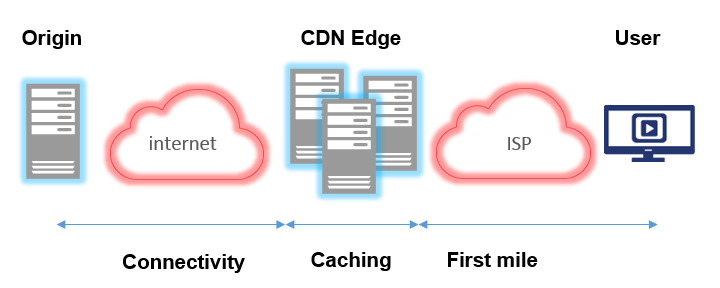
    I will highlight in the following what exactly Community RUMs measure, so you do not jump quickly to some wrong conclusions. Let's focus on the latency performance KPI and list the different components that contribute to it:
    • Last mile latency to CDN Edge, which reflects how near is it to the user from network perspective.
    • Cache width latency, which is mainly due to CDN Edge not having the content locally and must go get it from somewhere (Peer Edge, Parent Caching or simply from the origin)
    • Connectivity latency from CDN to Origin when there is a cache fill needed.


    In general, Community RUM measurements are based on calculating the time (RTD) it takes to serve users a predefined object from CDN Edges. Since the object is the same and doesn't change, it's always cached on edges. In consequence, Community RUM solely measure first mile network latency, which reflects sufficiently the latency performance of very high popular objects in cache.

    Nevertheless that's only a part of the picture. In real life, CDNs have different capabilities and strategies for storing content beyond Edges and filling it from origin:
    • According to content popularity, CDN cache purge policy, disk space available (Cache Width) on the Edge and Parent Caching architecture, the request will be a cache miss or hit with impact on performance. VoD provider with large video library know very well this topic. 
    • According to CDN upstream connectivity, the number of hops needed to fill from origin impacts connectivity latency. CDNs who built their own backbone benefit from a good upstream connectivity. Dynamic content is very sensitive to this aspect.
    As a final word, we also need to be aware that CDNs tend to optimize their configuration used by RUM measurement for this specific use case.

    lundi 10 octobre 2016

    Networks & economic paradigms


    I will start by the above revisited version of Maslow's pyramid for human needs. It's a funny expression of how internet is now a basic need, making all of us "data" consumers. Data delivery to consumers is organized in different ways, according to different economic models. In the following I will go through these different ways and their correlation to known paradigms for organizing economy: liberalism, centrally planned economy & participatory economy.

    The first paradigm is current internet decentralized organization which is based on liberalism or free trade, the dominant ideology nowadays. A user is connected to internet through eyeballs, e.g. the local ISP or mobile operator. Now eyeballs are connected to internet via different kinds of peerings:
    • Directly peer with content providers such as Google, Amazon & Netflix,
    • Peer with other regional eyeballs to exchange traffic directly,
    • Peer with backbone providers such as Level 3 & Cogent who globally connect eyeballs together.
    The dynamics driving network meshing are very interesting. An eyeball has many questions to answer in order to guarantee a good internet connectivity and a profitable business:
    • Which of the above peering kinds should we build? in which breakdown?
    • With which networks should we peer? what capacity? private peering or through internet exchanges?
    • In which geographical locations should we peer with a considered network? in which carrier hotels?
    • What is the cost of transport network to those locations?
    • Should we pay for a peering or is it free?
    • How should we diversify peerings to guarantee resiliency?
    The main driver of building internet networks is making profit because it is managed by private sector. Meanwhile, we have witnessed competition, price compression, innovation, rise of broadband.... But making profit means only serving solvable consumers, which has lead to the below unfair image of the world in terms of network connection density.


    The second paradigm is the organization of access network of a national eyeball which is based on central planning. Indeed, network expansion and deployment is planned according to usage forecasts given by marketing studies, and it's decided centrally by the eyeball in a top-down approach. The main driver of building such kind of networks depends on whether it is a public or private service, and on the telecom regulation pressure, thus leading to more or less fair network coverage.

    The main advantage of this model is a more rational and efficient use of resources (network assets, people) to satisfy the present and future needs of population. On the technical plan, network is more controlled and thus potentially providing better service, for example:

    • Traffic types (voice, download..) are differentiated and quality is manged from end to end.
    • Traffic routing is better controlled with any chosen protocol, where on internet only BGP can be used with its limitations.
    • Some specific techniques can be used to optimize the network usage, such as mutlicast for video streaming, where it's almost impossible on internet.
    But on the other hand, planning cycles have important inertia and often can't cope with demand dynamics. Moreover, eyeballs are not leaders in terms of innovation, for example, the ongoing SDN/NFV revolution in networks is driven by software companies like Google.


    The third paradigm is the FON model, based on participatory economy, i.e. network is crowd sourced by users themselves.


    As explained in the above video, a Fonero (user participating to the FON network) shares its home WiFi connection with others in a secure way, and thus has access to others' WiFi anywhere anytime. By making use of the idle bandwidth on your internet box, you gain access to thousands of hotspots around the world for free. It's the same concept of P2P for downloading files on internet.

    The main driver of such communities is making the world a better place in a bottom-up approach. Agility, innovation, open standards & free service are keywords in this model.

    As a final word, I personally believe in a 4th paradigm which is a mix of the last two. I will try to develop it in a future post.


    dimanche 4 septembre 2016

    Ce qu'il cache ce burkini ...


    Je vais m'en vouloir d'avoir participé à ce faux débat dans son timing, son ampleur et son champs d'analyse. Néanmoins, je vais en profiter pour revenir sur les notions théoriques de laïcité, liberté et d'égalité, pour ensuite commenter d'une façon plus pragmatique l'hypocrisie du débat ainsi que ses dessous politiques dangereux.


    U


    La meilleure définition de la laïcité que j'ai trouvée est chez Albert Jacquard: La laïcité consiste à prendre des décisions au nom des hommes, de leurs besoins et aspirations, non pas au nom d'une révélation externe telle une directive religieuse. Elle ne signifie pas la repression des religions comme on commence à le constater en France. Elle ne se limite pas non plus à la doctrine religieuse, mais toute doctrine qui nous parait aujourd'hui sacrée telle que le capitalisme avec ses valeurs de propriété privée et de compétition entre hommes dans une logique de marché. Dans ce sens, notre société occidentale est loin d'être laïque.

    La laïcité reconnait ainsi l’individu comme citoyen libre participant à la société, à son sort, et en faisant partie intégrante. Elle reconnait son identité, et l’aide à la forger. Quand l'individu se voit privé d'une réelle participation à la société, sa relation avec elle devient conflictuelle et peut finir soit par une révolte consciente, soit par une vengeance contre soi ou par une violence envers elle. Notre société occidentale avec sa démocratie délégative illusoire et la concentration du pouvoir dans les mains d'une seule classe sociale exclue des catégories entières (pauvres, femmes, immigrants...) de cette participation. Le fanatisme dans le monde entier est en partie la manifestation de cette exclusion, que ça soit religieux comme Daesh, ou politique comme l'extreme droite. En effet, c'est une recherche d'identité qui peut devenir suicidaire comme dirait Amin Maalouf, surtout en l'absence de forces révolutionnaires aiguillant la colère.

    Donc la citoyenneté nécessite comme condition la liberté de l’individu, mais encore faut-il définir cette liberté. La liberté d'un individu dans une société n'a pas de sens que si elle est associée à des contraintes. Cette dynamique de liberté-contrainte nourrit la participation du citoyen à sa "cité" et lui donne du contenu, mais à condition qu'elle soit égale pour tous les citoyens. L’équilibre auquel arrive cette dynamique résulte du dialogue continuel des individus avec la société, qui est au final le synonyme de leur participation. Cet équilibre n'est pas immuable, mais évolue avec l'évolution de la société. C'est dans cette optique que je voudrais considérer le burkini. La liberté de le porter est associée à la contrainte des autres de le voir, et donc la contrainte de voir les autres aussi  exercer leur liberté de s'habiller. Je pose ainsi les questions suivantes:
    • Est-ce que les femmes portant le burkini ont eu la possibilité de participer réellement à la société?
    • Est-ce que leur identité forgée est le résultat d'une libre participation? d'un dialogue avec la société?
    • Est-ce qu'on a considéré la dynamique liberté/contrainte de s'habiller en respectant le principe d'égalité?
    Non à mes yeux. Personnellement je considère le burkini comme un syndrome de la domination masculine sur les femmes, mais je crois que le seul moyen d'en finir est d'inviter les personnes concernées à participer librement et d'une façon égale à la société. Toute attaque aux syndromes, sans considérer la maladie, ne ferait qu'aggraver la maladie.

    Maintenant passons à l’aspect plus concret du débat burkini en France. Il est hypocrite parce qu'il se réclame défenseur des droits de la femme alors que c'est probablement le sujet le moins structurant dans cette thématique par rapport à d’autres sujets comme le salaire des femmes comparé à celui de l'homme, la reconnaissance de la grossesse comme travail... Il est aussi hypocrite parce qu'il se réclame défenseur de la laïcité, alors qu'on tire dessus à chaque décision prise au nom du peuple mais qui n’émane pas de celui-la, comme par exemple en utilisant l'article 49.3.

    Enfin, le vrai enjeu derrière toute cette polémique est d'ordre politique afin de mobiliser les gens, de récupérer les voix et de détourner l’attention. Le danger de ce jeu c'est de pousser plus les gens dans le fanatisme et préparer les identités meurtrières de demain.


    mercredi 23 décembre 2015

    Digital detox

    I belong to generation Y and I know what it means to be addicted to smartphones, to Facebook, to Whatsapp... But as Socrates said: "I know that I don't know", i.e. I am conscious about it and trying to improve how I consume digital media in order to keep my psychological health in shape. There is a lot of articles on the subject, my goal is to share some tips and tricks from my personal experience. I will not discuss the dangers of social media (use of data, manipulation...) nor how digital is disconnecting us from reality (little birds singing on trees).

    So why psychological health? because it's as important as physical health but we always tend to ignore it.
    The first syndrome of digital addiction is decreasing concentration. Indeed, we are continually interrupted by notifications and can rarely focus on an idea for longtime, leading us to less mental efficiency and serenity.
    The second syndrome is emotional dependency on "virtual". We humain beings need to be loved, to be noticed, to be surrounded. Evolutionary psychologists believe it is the result of years of evolution where humain beings, living in tribes, could not survive alone. Being ignored in a tribe means the risk of death and not passing his genes, thus we developed a warning mechanism associated with pain. Researchers have proved that the same areas of our brain are activated when we experience rejection or physical pain. Before digital era, people counted solely on family, on partner, on friendships to satisfy this need of belongingness. Nowadays we rely a lot on virtual "likes" of almost unknown people, which can be devastating when it disappears, because its just virtual!


    So how am I trying to have a better control on all of this? here are four advices I am experimenting:
    • Use the right media for the right communication. For simplicity, let's consider that there are two types of communication: type A, important and need to reply or take actions rapidly, and type B the less important one. We should use an adapted channel for each type, for example type A requires a channel with instant notification, like SMS, and type B requires non instant channel like Facebook messaging. It means you should deactivate notification from Facebook, and never use it or let your contacts use it for important matters. That lets you avoid the need to check Facebook regularly for type A messages.
    • Separate being informed from being entertained. It should be clear in your mind, when you are consuming digital, whether you just want to lose time or obtain information. Personally, I have created two Facebook accounts: a first one where I have fun looking to friends posts and interacting with them, and a second one with no friends, but with only subscription to theater pages, news, articles, music... 
    • Put some constraints. I am testing for example the following constraints: keep the phone in your pocket hidden from your eyes, do not check your phone when in presence of others (good for respect too :)), log out each time you go to Facebook, power off phone at night, limit digital consuming time per day...
    • Be conscious of your usage. The first idea is to know how much you spend on your phone during a day. I tested an app on Android called Quality Time that shows you how much you use each app. I was shocked when I discovered that I can unlock my phone screen up to 200 times a day! The second idea, a very important one, is to ask yourself each time you want to use your smartphone why I am doing this? what motivated me? what am I looking for?


    To be honest, I am still far from my goals, but I am happy to be conscious about it, and that's the most important step !

    lundi 21 décembre 2015

    Increase QoE of video streaming by optimizing the encoding of the video library

    A week ago, Netflix engineers have revealed a project on which they were working for some time now to optimize the QoE of videos they are streaming to their subscribers. Their approach is based on video encoding settings in the back-end rather than focusing only on the front-end (peering, codec, streaming format, CDN..). The expected gain is 20% on overall traffic which is huge for a player who is accounting for more than third of the global internet traffic. Additionally, Netflix will be delivering better quality at the same connection bandwidth, which is critical for addressing emerging markets.

    Content providers encode several representations of the same video asset, where each representation is formed by a bitrate and a resolution. below is an example of representations of a 4:3 main profile video according to Apple recommendations:


    The goal of having several representations is serving the best one to the user according to his screen (TV  vs  mobile) and connection (4G, ADSL, FTTH..). With adaptive streaming, the same user can change the representation during video play in order to adapt to the connection bandwidth variation. 

    So far content providers encoded all their video assets with the same set of representations. Netflix noticed that it doesn't make sense because for the same quality/resolution a cartoon movie requires less bitrate that an action film. Each video asset has its own "entropy" that should be taken into consideration when generating the representation set. This what Netflix is doing with their per-title encoding approach. 

    In order to know what is the best representation set for a title, Netflix will encode at different resolutions (480p, 720p, 1080p...), then for each resolution they will draw the "exponential" curve of quality (PSNR) vs encoding bitrate (black, green and blue curves). Notice that a 720p @ 400Kbps representation will have a worse quality than a 480p representation encoded at the same bitrate and upscaled to 720p. The optimal representation set will be the set of dots close to the red curve.


    Of course this approach will cost more computing resources in the video preparation workflow, but the gains are worth it.

    On the same subject, I read this interesting scientific article, where they propose not only looking to the type of the title (cartoon vs action film...) but also to its popularity, to the limits of contracted CDN capacity, of users screen resolution, of users connection, video storage... They make interesting findings on the optimal representation set:
    • Titles with high "entropy" like action film requires more representations than low "entropy" titles like cartoons.
    • The number of representations per resolution is dependent on the distribution of devices: HDTV vs mobile phones.
    • For a given resolution, lower bitrates are closer one to the other than higher bitrates.
    Of course these are the conclusions of the test conditions. It can be different for exemple if we consider a content provider targeting only mobile devices in emerging markets.

    As the environment of the content provider is smoothly changing (proliferation of mobile devices, conquer strategies for emerging markets with low bandwidth connections, title popularity changing, versatile peering agreements...) I guess it would be interesting to dynamically re-encode in a continuous way the representations of the video library in order to guarantee the best global user QoE with respect to constraints imposed by this moving environment.


    samedi 17 octobre 2015

    On education

    What do you think about the fact that our children are taught with the same system as our grand-grand-parents? Our world changed drastically but our education system is fundamentally the same since more than 100 years, even if we now use tablets rather than chalk boards. Through this article, I am contributing to the abundant literature on this subject, but from my point of view.


    The main problem of our education is focusing on succeeding and not learning itself. I remember my self that my goal during school and even during university was succeeding exams. What about knowledge itself? it becomes a side effect of getting A grades, rather than being the ultimate goal. It's just now that I go back to my old school books and seek knowledge, now that I don't have to prove anything by exams.

    Another important issue with our education is preparing young people for being misinformed, followers, and almost misanthropic (oh yes!!):
    • How many school teachers gave its students the keys to find information and create their own opinion, instead of just stuffing kids with already mashed information & believes? I like the image given by Marshall Rosenberg in one of his conferences to illustrate this process of teaching: The teacher is a bottle of milk and the children are empty glasses. At the beginning, the bottled pours milk in the small glasses. During the exams, the glasses pours the milk back in the bottle. What we have left with in the end? a bottle with less milk surrounded by dirty and empty glasses.
      Look at scholar history books, most of them give the national understanding of the history, instead of letting the students debate and form their own opinion. It is a fuel for the continuous conflicts we are witnessing in the world.
    • In the same idea, we kill the creativity of kids by teaching them only convergent thinking. How many geniuses failed schools because of their creativity/divergent thinking? I have written about it more in detail in this previous article.
    • What about teaching kids to collaborate instead of competing? I really like what Albert Jacquard says about this aberration which is competition. Teach kids to realize themselves through others and not against them.
    • Through my professional experience, I have seen a lot of inefficient conflict situations because of misunderstandings. Colleagues were not able to put themselves in the skin of others, as simple as it seems. We urgently need to teach our children empathy and non violent communication.
    The third major point I want to mention about current education, is its tendency to form very specialized people with kind of horse tacks on their eyes. I mean by that their blindness toward subjects different than their own field of specialties, what Nicolas Nassim Taleb calls tunneling. Take for example an economist who conceives the world through only financial equations without taking into consideration ethical matters. Oups, this economist existed indeed! David Ricardo, thanks to whom capitalism started to become financial, leading to modern disasters like the 2008 subprime crisis. It's very dangerous to have such specialists in our butterfly-effect-world. We need specialists, but with enough general culture and knowledge. For example I have heard about some initiatives in a Scandinavian country, where per-matter exams are replaced by multidisciplinary school projects.

    One final thing i want to mention about this subject is the lack of spiritualism in schools. I remember that school was a race of succeeding exams, to finish and start real life of working and producing like machines. I don't remember just sitting, thinking about my existence, enjoying and appreciating the beauty of the world, the nature and the human being. I would have loved someone to send me philosophical letters like Sophie the fictional character of Jostein Gaarder. I no wonder that so many of us face existential crisis at some point of life.

    Education is the door to the evolution of our civilization, I doubt profoundly any evolution based on a 100 years old system.


    dimanche 19 juillet 2015

    Third industrial revolution?

    Well yes, a big shift in economy is happening in our digital era. Economy is moving from a centralized production system to a more distributed one with the help of internet and information technology. It means that people exchange directly goods and services without the direct need of traditional intermediate corporations. I will illustrate this shift through examples from different sectors:
    • Transportation: Uber is destabilizing the taxi industry by its model where non professional drivers serve directly passengers with a sexy and real time mobile application. Before Uber, car pooling was growing for inter cities transportation and thus competing lightly with trains & buses.
    • Hospitality: With the same spirit, AirBnb is threatening the established business of hotel chains, especially on the low-end tourism market. Couchsurfing also took a part of this market somehow.
    • Energy: Consumers are called to be micro producers through solar energy for example. Energy production would be managed intelligently with smart grids and moreover with connected objects.
    • Consumer Goods:  We are witnessing the emergence of websites praising the reuse of consumer goods such as: toys, tools, high tech products... and more generally products that are not used frequently so people rather prefer to rent it. Some even say that this pushing the notion of private property to disappear!
    • IT: Instead of centralized datacenters, a new buzz word is here: fog computing. A more distributed architecture than cloud computing, where end devices stores and process information. I was especially impressed by the French Startup Qarnot Computing who proposes computing capacity through its distributed servers in households. Their brilliant idea is heating households using installed servers!
    • Finance: Who of us didn't participate through crowdfunding to help the project of an association? the launch of music album? the new idea of a startup? Banks/business angels/love money will not stay the exclusive ways of funding ventures.
    Some, like Jeremy Rifkin, call this shift a revolution, the revolution of "commons", a "croudsourced" economy that seems more just and equal. Well, I do not share this point of view. I think that distributed model disrupt the structure of the players in our market based economy, but it does not change the capitalist nature of this economy: private property, seek for profit, class differences... indeed, the established corporations (see above for examples) will loose power to new players who control information. If we take the example of hospitality industry, well yes some big hotel chains will hardly survive in front of Airbnb, but this online platform would behave just as its old competitors: hire employees, look for profitability, compete to have a monopole...


    Nevertheless, this shift might provide a good basis for a real conscious revolution on how we manage economy today.  When individuals are more involved in the production system, not as work-providers but as contributors, they will want to contribute also to decision making. What is really missing is a distributed decision making, a real democracy! Digital revolution is a wonderful opportunity for achieving this. I like very much the example of an Argentinian political party (Partido de la red) who's representatives only vote in parliament what people has decided online (Democracy OS).

    vendredi 3 juillet 2015

    Revealing networks


    After a couple of years dealing with networks of mid-sized and large companies, I noticed that networks reveal many aspects of companies culture, organization and history. In the following, I will just give some seen examples from my own experience.


    • Often when you find a network with isolated subnetworks, using for example multiple VRF mechanism in MPLS, it reveals a history of successive acquisitions of external companies, who managed to keep their IT independence. That can be also the case of a multinationals who's regional IT gained enough independence.
    • Networks also give an idea about the kind of skills available in the IT department, and sometimes its size: Big IT departments with network gurus are more likely to prefer do-it-your-own solutions such IPSEC based networking with focus on non-standard technical needs. Smaller IT departments, or those who are more business aligned, go for managed services with focus on SLAs and end user features.
    • Speaking of SLAs, I noticed that some IT buyers prefer to focus only on SLAs without taking into consideration the underlying technical design. That is typically the profile of buyers who is actually not looking for reducing the risk, but only to transfer it to the provider. It can reflect a culture of protectionism.
    • More generally many cultural aspects are reflected by the network design. For example the design of external connections to the private network gives an idea of  how much a company trusts its employees, accepts new generations paradigms (BYOD, ATAWAD..), is obsessed with security... We can also know more about how much the IT decision makers are conservatives. That can be detected for example by how they embrace new technologies and solutions: cloud, hybrid networks... Finally, I noted some correlation between how much the company is politicized and what differentiated services are provided to VIPs by the IT department!

    vendredi 12 juin 2015

    Agile, but quality delivering organization?

    I had the chance to work within a mammoth organization who is undertaking ambitious transformations in order to be more agile. I would like to talk about this subject with a focus on processes.

    So why we need processes?  In a mammoth organization, processes guarantee quality. Indeed, when we have so many people doing different activities on many products in different locations... things get really complicated! thus we need to organize the interactions among people to minimize operational and financial risks, and provide fine KPIs for management. Moreover, processes reflect the learning curve of an industrialized organization and give an important guidance framework for employees to work conveniently.


    Unfortunately, depending on their design and philosophy, processes can increase dramatically the inertia of the mammoth, thus its efficiency, and create a huge frustration among employees and customers. I noticed that when you design a process as taylored-style black boxes with inputs and outputs, well, the people inside these black boxes just get blinded!!! Indeed, the result is dilution syndrome:
    • Dilution of information: precious information get lost through the process.
    • Dilution of responsibility: In crisis, it becomes difficult to identify a clear responsible for resolving the problems, instead each actor hides behind its process! That doesn't help people develop sense of autonomy.
    • Dilution of purpose: employees forget about the final purpose for which the process was made, and the process becomes the purpose itself!
    Well, we are not in the Ice Age anymore, and Mammoths should evolve in order to survive. The winning DNA is agility in our age, the age of quick changes, real time information, incertitude and globalization.
       
    So how can we get agile, but quality delivering organization? In my point view, a couple of aspects must be well considered:
    • Is a process always the solution for a workflow? I don't think so. Project management can be better adapted in certain cases. The choice can be made according to the complexity and the stakes of the workflow. Hybrid paradigms can be thought of also, for example designing only high level processes and giving more flexibility to actors.
    • Actors of the process must understand the process globally and especially it's final purpose. The management must develop a collaborative culture with transversal skills, and autonomy.
    • Set up 2.0 participative mechanisms for improving processes rapidly by managers and users.
    • Provide digital tools respecting the philosophy of the previous aspects: knowledge management, collaborative and communication tools, intelligent workflow tools...
     Mammoths, be aware of natural selection!!!

    mardi 24 mars 2015

    Choose to be positive!

    We all can have difficult moments at work: conflicts, misunderstandings, stress... and quite often we tend to fall in a negative attitude where we play the victims and behave in an aggressive way. Well, we simply shouldn't! I believe that in most cases, we can easily avoid and master negative feelings. Indeed, we first need to acknowledge the existence of these negative feelings, then to consider objectively their causing environment, and finally to find the positive elements in this situation.

    I would like to focus on two kinds of situations: doing a required but painful activity and being in conflict with other people at work. I will discuss them through examples from my personal experience.

    In the first kind of situations, we are asked to do something that we perceive as painful:
    • As presales engineer, I had to reply to an energy consuming RFP which I knew in advance our zero chance to win. That was really stressing and frustrating but I got conscious about my negative feelings. My first action was to challenge my management in order to define reasonable objectives of our answer to the RFP, thus increasing my chances to reach them. This way, I have acted directly on the causing environment. Then I tried to figure out what benefits I could make of my investment on the bid even if I loose it: new skills in bid management, working with new people...Well, I lost the bid unfortunately, but I do not regret this experience, on the contrary, I learned a lot from it. Moreover I am better prepared psychologically for similar situations in the future.
    • In a general way, when we are asked to get out of our comfort zone, we get overwhelmed by negative feelings of stress and apprehension: change job, work on new technology, take a new challenge... Personally, I consider now going out of my comfort zone as a sport but for my intellect. Indeed, sport can be painful when practicing, but on the long term it improves health and it even becomes an addiction.

    In the second kind of situations, we are in conflict with people at work: a colleague not helping you in a project, a client almost insulting you...I think that the key is to think in a materialistic way instead of considering people as mean or unskilled. In a materialistic thinking, you ask your self what are objectively the factors that hold my colleague from working on my project? We must try to put our self in their skin and understand their conditions and constraints: Your colleague might be overloaded with other more important projects. Open and regular communication with others is essential to better master our negative feelings toward them.

    In all situations, you have a lethal weapon for positive attitude: your smile :) Smiling is not opposite to being serious! I do believe that just by smiling sincerely and freely to others we drive everybody into a positive karma, including ourselves :)


    I'll finish by saying that it is up to you to decide to be in the positive virtuous cycle or the negative vicious cycle.

    vendredi 27 février 2015

    The Black Swan


    I finally got the opportunity to read the best-selling book The Black Swan by the Lebanese-American professor Nicholas Nassim Taleb. I am not a big fan of best-sellers, but this book is unique in its kind. Indeed, the author develops his thoughts across several disciplines (risk analysis, finance & economy, statistics, epistemology, history, philosophy...) in a funny and entertaining writing style.


    Although I found the book a bit long and redundant, the exposed idea is very interesting. Black Swan symbolizes rare events that have big impact, such as tsunami, financial crisis, music hit or world war. I will talk about the main idea that interested me in the book: our blindness to Black Swans.

    We believe that we made reliable predictions using verified models, until we get surprised by a sudden collapse of Wall Street... Taleb explains that our blindness to Black Swans is due to cognitive biases. These biases are strongly rooted in our biology because the evolution of humans have taken place during thousands of years in a linear environment with no significant deviations. Today, things have changed with free markets, globalization and technology. Our world is not linear anymore! Indeed, one can become rapidly millionaire by investing in a lucky startup or can cause a financial crisis by a trading transaction...

    The first bias is the confirmation error or the induction problem. We tend to generalize from empirical observations thus building fragile theories that are very vulnerable to improbable events. Europeans always thought that all swans were white, since all the swans they observed were white, until the day that they discovered a black swan in Australia. Serial killers have a clean record, until the day they murder their victims!
    Moreover, generalizing from empirical observations get worse when we mis-estimate the representational value of the observed sample. Consider this conclusion: "In my startup I will adopt the X management style, because CEOs of successful startups recommend it in management magazines."  Unfortunately, this is a Black-Swan-exposed conclusion, because CEOs of bankrupted startups are not invited to write about this management style in business magazines!

    The second bias is the narrative fallacy. We constantly need to put events in a reasonable story with causal correlations in order to mentally digest them thus making us blind to random events escaping this pattern. This explains why sometimes we fail to predict events in he future, but typically find logical interpretation to them after their occurrence. Everybody can explain the causes of the second world war, but can we predict the next war? how many people would have imagined the "great" war a week before its start?

    The third bias is emotional, and can have different aspects. It strongly reminded me of Treblinka a novel by J.F. Steiner which is based on the true story of an extermination camp in Poland. Steiner argues that Jews of Poland heard horrible witnesses of many escaped prisoners from camps, but however unconsciously refused to believe the existence of such a cruelty and thus were lead easily to death camps without resistance. they emotionally got blinded by a fake hope. "Human nature is not programmed for Black Swans."

    The last bias is "tunneling", also the expert syndrome. In fact, experts that make prediction models do not see risks outside their expertise domain, their tunnel. A financial company would hire the best mathematicians to find prediction models in order to reduce risks of market fluctuations, but forget to put in place a Recovery Plan for its Information System/Datacenter thus completely risking its existence. We live in the era of butterfly effects, where a terrorist from Afghanistan can bring down two sky scrapers in the USA, leading to important changes in cloud hosting business in Europe. We should look to what's happening outside of our tunnel.

    When you read with Taleb about the flaws of predictions and the impact of randomness in history, you might fall rapidly in obsessional skepticism and non-decision attitude. Well, that is not the author's intention. He is inviting us to understand the limits of our knowledge in this non-platonic world and act upon it, to be conscious of our UnKnowledge and stop epistemological arrogance in order to avoid negative Black Swans. Furthermore, Taleb explains how to get more exposed to positive Black Swans and benefit from them!

    PS: This book was dedicated to Benoit Mandelbrot, the famous mathematician who gave more importance to randomness and chaos in scientific approach with his fractal theory.